Good Business Practices For Affiliate Marketers


Affiliate marketing remains one of the most accessible and scalable ways to generate income online, but the landscape as the year progresses is more competitive and fast-moving than ever.
What Affiliate Marketing mean in modern times
Between evolving SEO algorithms, AI-driven personalization, and changing consumer expectations, success requires both strategy and adaptability.
Even if you’re a beginner or an experienced marketer, the following good affiliate marketing practices will help you build authority, grow your audience, and increase conversions while maintaining credibility.
These practices are:
1. Work on Your Business Every Day
Consistency is still the ultimate growth hack. Dedicate time daily even if it’s just 20 minutes to improve your affiliate marketing business. The work could even be in small ways. This could mean:
- Updating an old blog post with fresh keywords and AI-enhanced visuals.
- Engaging with your audience on social media or answering niche-specific questions in forums.
- Testing a new email subject line for higher open rates.
These small, daily actions compound over time, helping you avoid burnout while building steady momentum.
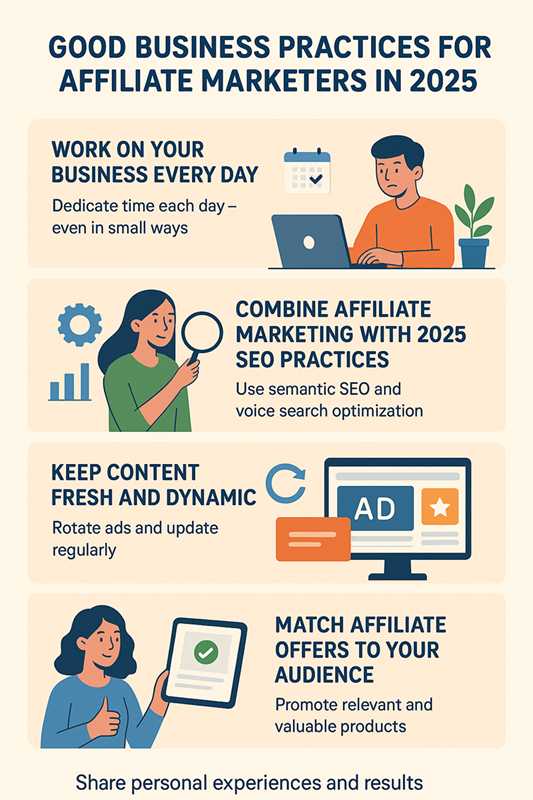
2. Combine Affiliate Marketing With Best SEO Practices
Search engine optimization is still a core driver of affiliate traffic, but it’s no longer just about keywords.
- Use semantic SEO: Target topic clusters and related queries instead of single keywords.
- Optimize for voice search: People are now using AI assistants to find recommendations.
- Use structured data markup: This increases the chance your product reviews or comparisons show up as rich snippets.
When you aliging your site’s content with what your audience is actively searching for, you will increase click-through rates and conversions.
3. Keep Content Fresh and Dynamic
A static site nowadays is a dead site. If visitors keep seeing the same banners, headlines, or offers, they’ll assume your site is outdated.
- Use ad rotation tools or AI-based content personalization to keep your page dynamic.
- Experiment with different calls-to-action (CTAs) and test their performance with A/B testing.
- Keep seasonal and trending products visible, especially during high-conversion periods like Black Friday, back-to-school, or niche-specific events.
4. Match Affiliate Offers to Your Audience
Relevance drives conversions. If your blog is about sustainable living, promoting eco-friendly products will perform far better than random tech gadgets.
- Study your audience’s buying behavior through analytics tools.
- Use AI-driven affiliate networks that recommend products based on your content niche.
- Avoid promoting items you wouldn’t personally use or that conflict with your audience’s values.

5. Build Trust Through Honest Endorsements
In an age of AI-generated content, authenticity is your competitive edge.
- Share personal experiences and results with the products you promote.
- Include both pros and cons in reviews to maintain credibility.
- Avoid hyping products and services. Consumers tend to be more skeptical and fact-check these products and services before purchasing.
6. Focus on Content-Rich, Value-Driven Pages
Affiliate success depends on giving visitors a reason to trust your recommendations.
- Create deep-dive product guides that answer every possible question.
- Use comparison tables to help readers make quick decisions.
- Add short-form video reviews or demos directly into your content for higher engagement.
The goal is to become the go-to resource for your niche.
7. Network and Collaborate Within Your Niche
Building relationships in your industry will open doors to exclusive offers, guest posting opportunities, and co-promotions.
- Participate in niche-specific LinkedIn groups, Reddit communities, and private Slack channels.
- Offer to collaborate on joint webinars or live Q&A sessions with other creators.
- Maintain relationships with affiliate managers. These affiliate managers can grant you higher commissions or early access to campaigns.
8. Refresh Your Ads and Content Strategy Regularly
Attention spans are shorter than ever. Rotate creatives, test new affiliate products, and use interactive formats.
- Try shoppable videos on TikTok or Instagram.
- Experiment with AI-personalized landing pages that adapt based on user behavior.
- Track what performs best and replace underperforming ads quickly.

9. Write Transparent, Balanced Reviews
Product reviews still convert well, but only if they feel genuine.
- Disclose affiliate relationships upfront as transparency builds long-term trust.
- Use your own photos or videos to prove you’ve actually used the product.
- Include specific use cases and who the product is not for.
10. Embrace Multi-Channel Affiliate Marketing
You don’t have to rely on one traffic source. Algorithms change overnight. In recent years, affiliate marketers are diversifying more than ever.
- SEO-optimized blog posts for long-term organic traffic.
- TikTok, Instagram Reels, and YouTube Shorts for rapid exposure.
- Email marketing sequences for nurturing repeat buyers.
- AI-driven retargeting ads for abandoned cart or product page visitors.
The more channels you tap into, the more resilient your affiliate business will be.
In conclusion, Affiliate marketing is about relevance, trust, and adaptability.
When you consistently provide genuine value, maintain fresh and engaging content, and diversify your traffic sources, you’ll not only boost conversions, you will also future-proof your income.
The above strategies reflects modern day algorithms, consumer behaviors, and monetization tools which are subject to change at any time in future.
Author Bio
This user has not submitted a user bio yet
Article Comments
No Comments!
At present there are zero comments on this article.
Why not be the first to make a comment?
Similar Articles
Sponsor
Search Articles

Experts Column
Latest Articles
Featured Articles








Most Popular Articles